
Real-time architecture. Built for enterprise scale.
Architecture decisions made for CTOs, CIOs and enterprise IT teams — event-driven, API-first and deployment-flexible from day one.
Engineered for high-throughput,
low-latency decisioning.
A modern, composable architecture underneath every BANKiQ deployment.
Every transaction, login and account event streams through the platform as it happens, not in batch.
Producers publish domain events (payment initiated, device bound, beneficiary added, credential changed) onto durable topics, and every downstream consumer — scoring, profiling, case management, reporting — subscribes independently. Because state is rebuilt from the event log, a replay of yesterday's traffic against a new rule set is a routine exercise rather than a project, and no consumer outage loses data.
Independently deployable, independently scalable services rather than one monolithic engine.
Rule execution, model inference, entity resolution, alerting and case workflow each run as their own service with their own release train and scaling profile. A festival-season surge on UPI scoring scales only the scoring pods; a model refresh ships without regression-testing the entire platform; and a fault in one capability degrades gracefully instead of taking decisioning offline.
Every capability is exposed as an API — built to integrate into existing infrastructure, not replace it.
REST and streaming interfaces are versioned, contract-tested and documented with OpenAPI, so channel teams integrate against a stable specification. Synchronous decision APIs return an approve / step-up / block verdict with reason codes, while asynchronous APIs cover case creation, list management, model feedback and regulatory extracts.
High-throughput streaming pipelines carry event data across the platform with minimal latency.
Partitioned topics keyed by customer and account preserve ordering where it matters while allowing parallel consumption everywhere else. Retention, compaction and dead-letter handling are configured per topic, and consumer lag is monitored as a first-class SLA so slow downstreams are detected long before they affect decision latency.
Tested at 750+ TPS with linear performance scaling as volume grows.
Benchmarks are run against production-shaped traffic mixes — UPI, IMPS, NEFT, card and net-banking events together — rather than a synthetic single-rail load. Throughput scales close to linearly with added nodes because state lookups are partitioned and cached, so capacity planning becomes an arithmetic exercise instead of a re-architecture.
Decisioning capability designed for sub-100ms response, so risk checks never slow the customer down.
Hot profile state, velocity counters and graph adjacency are held in memory close to the scoring path, so a full evaluation of rules, models and network signals completes inside the payment window. Latency is tracked at p50, p95 and p99 with circuit-breakers and configurable fail-open or fail-closed behaviour per channel.
Deploy on public cloud, private cloud or a hybrid footprint without re-architecting.
The same container images, Helm charts and configuration model run across AWS, Azure, GCP, a hosted single-tenant estate or your own data centre. Infrastructure is described as code, so environments are reproducible and a move between footprints is a deployment decision rather than a rewrite.
Container-orchestrated deployment with service-mesh traffic management for resilience at scale.
Rolling and blue-green releases, pod autoscaling and self-healing are handled by the orchestrator, while the mesh provides mTLS between services, retries, timeouts, circuit-breaking and fine-grained traffic shifting. Canary releases of a new model or rule pack are routed to a slice of live traffic and rolled back automatically on error-budget breach.
Redundant, fault-tolerant infrastructure built to keep decisioning online.
Active-active clusters across availability zones, replicated state stores and health-checked load balancing remove single points of failure. Disaster-recovery targets are defined as explicit RPO and RTO commitments, and failover is rehearsed rather than assumed.
Add capacity by adding nodes — architecture scales out rather than requiring a forklift upgrade.
Services are stateless wherever possible and shard state by entity key where they are not, so additional replicas absorb volume immediately. Autoscaling policies respond to queue depth and decision latency rather than CPU alone, which keeps headroom available for the bursty traffic patterns typical of fraud events.
Encryption in transit and at rest, role-based access and least-privilege service design throughout.
TLS everywhere, key management through an external vault or HSM, tokenisation of sensitive identifiers and granular RBAC restrict what each user and each service can reach. Secrets never live in images, administrative actions are separately logged, and security testing is part of the build pipeline rather than an annual event.
Deployment models that keep sensitive data within the boundaries your regulator requires.
Data can be pinned to an in-country region or your own data centre, with masking, field-level encryption and configurable retention applied by data class. Purpose-bound access, consent-aware processing and auditable export controls support DPDP-style obligations without cutting analysts off from the context they need.
Your infrastructure, your choice.
BANKiQ deploys the way your institution needs it to — with the same platform underneath.
Cloud
Fully managed public-cloud deployment for institutions that want to move fast without managing infrastructure.
Hosted Cloud
A dedicated, single-tenant cloud environment for institutions that need isolation with cloud-grade elasticity.
On-Premise
Deploy within your own data centre for full data-residency and infrastructure control.
Professional Services
Implementation, integration, tuning and managed-service support across every deployment model — from initial rollout through ongoing rule and model optimisation.
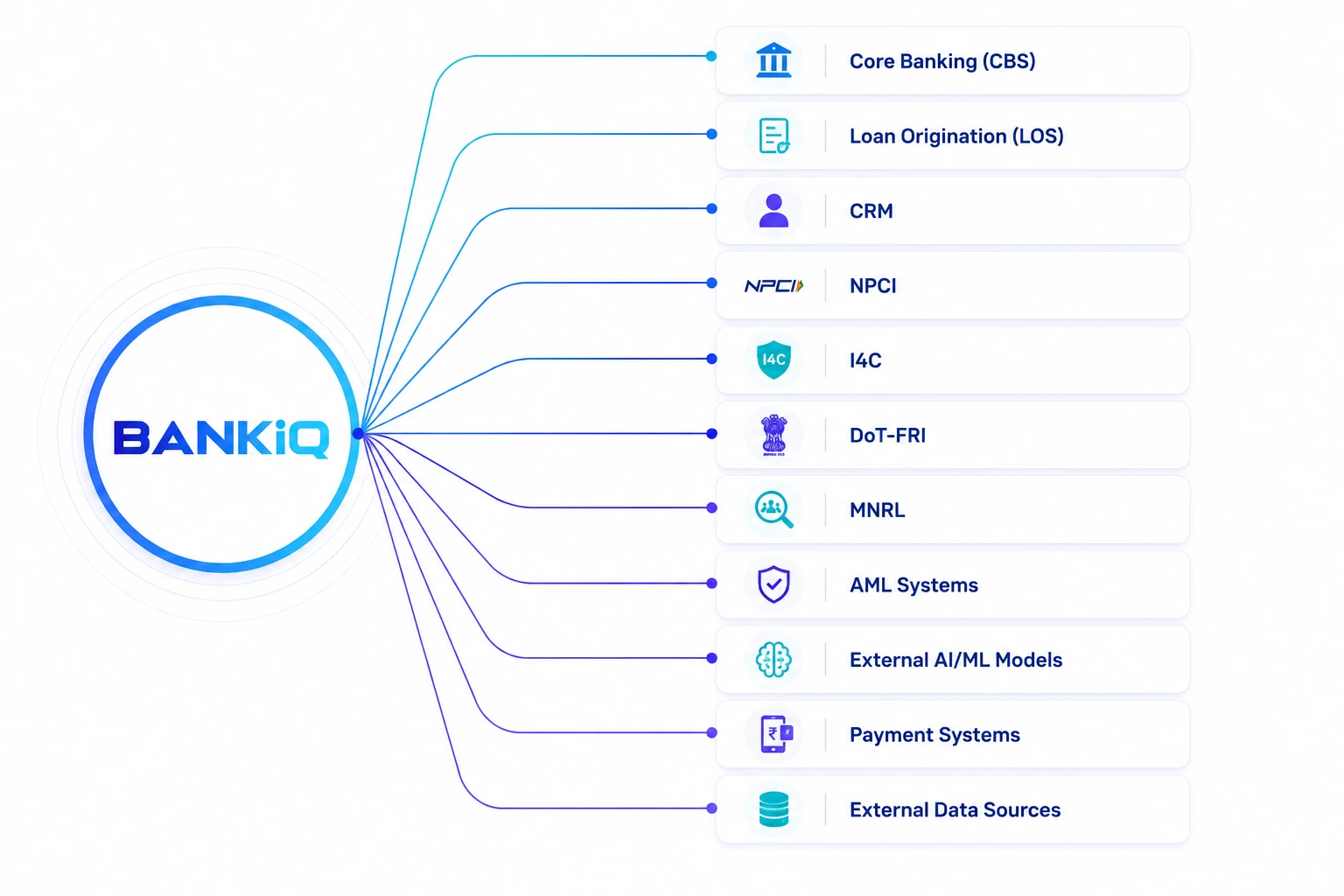
Connects into the systems you
already run.
BANKiQ sits alongside your core banking and regulatory ecosystem — not in place of it.
Built with the regulator in mind.
Compliance isn't bolted on afterward — it's part of how the platform is designed to operate.
RBI-Aligned Controls
Designed to align with evolving RBI fraud-risk and governance expectations.
Control design maps to RBI master directions on fraud risk management, digital payment security and IT governance, with evidence packs ready for supervisory inspection.
Regulatory Reporting - CPFIR, STR, ATR, FMR etc
Streamlined regulatory reporting workflows connected directly to case management.
CPFIR, STR, ATR and FMR submissions are generated from investigated case data with prescribed formats, validation and filing timelines tracked end to end.
Full Audit Trails
Every decision, override and case action is logged for supervisory review.
Immutable, time-stamped records covering rule versions, model versions, scores, analyst actions and system overrides are retained for the full statutory period.
Maker-Checker Controls
Segregation-of-duties enforced across rule changes, overrides and investigation workflows.
Dual authorisation with configurable approval hierarchies applies to rule promotion, threshold changes, list edits and case closure, and every approval is attributable.
Governance capabilities support your institution's compliance programme; they do not substitute for legal or regulatory advice specific to your jurisdiction.
Have a specific architecture question?
Talk to our technical team about integration, deployment and scalability for your environment.